
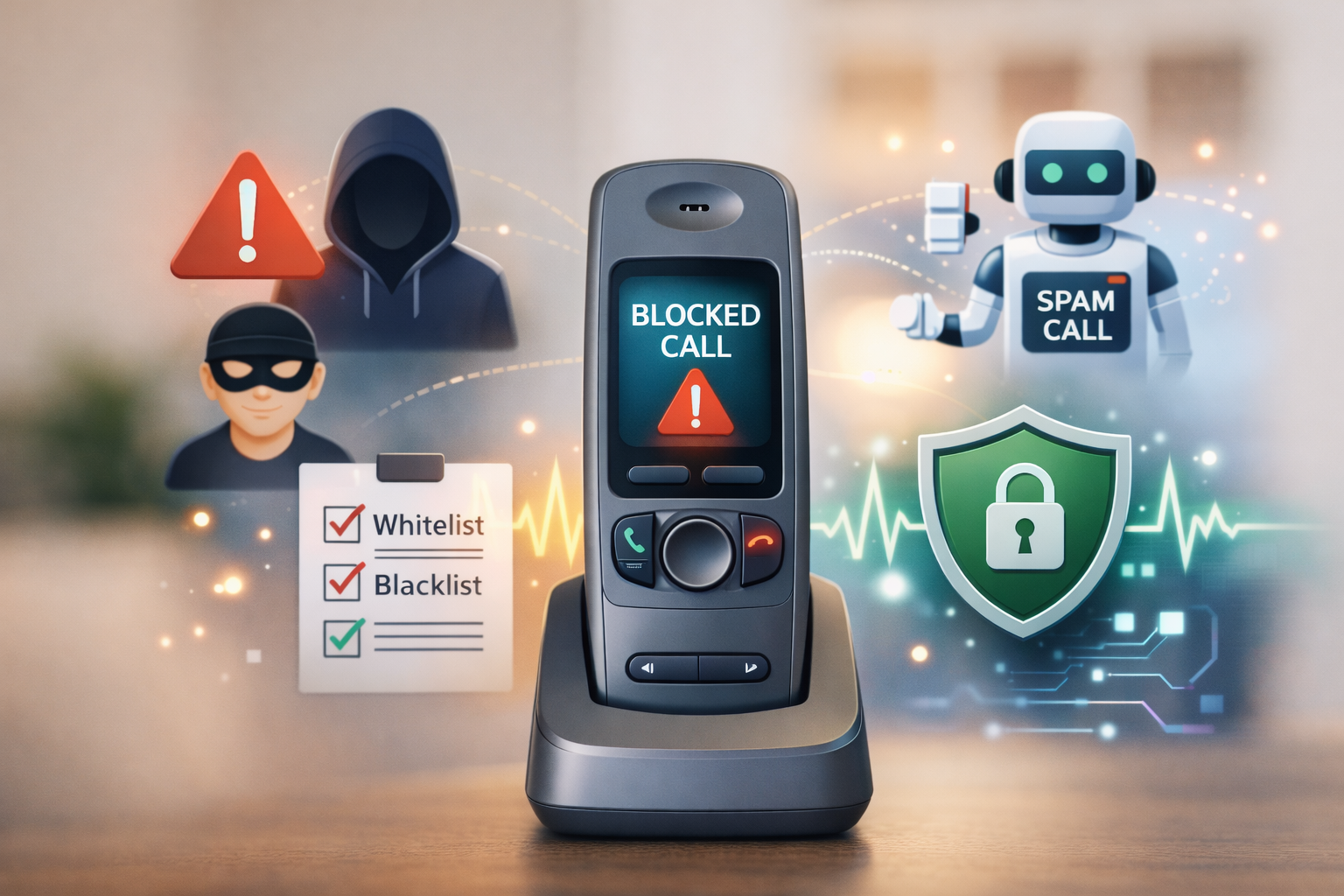
For many households, the home phone line still represents something simple and reassuring: a direct way to reach family, friends and essential services.
Unfortunately, it also remains one of the most exploited channels for fraud.
From spoofed caller IDs to automated scam campaigns and social engineering attacks, residential phone numbers are regularly targeted --- particularly where vulnerable individuals are involved. Traditional call blocking and basic caller ID are no longer sufficient safeguards.
The question is no longer whether nuisance or fraudulent calls will happen. The question is how residential lines can be redesigned to prevent harm while remaining simple and accessible.
This article explores practical approaches to improving privacy and fraud prevention on residential phone services, and how modern call control tools can dramatically reduce risk.
The Evolving Risk Landscape
Telephone fraud has become more sophisticated in three key ways:
1. Automated Mass Dialling
Robocall systems can place thousands of calls per hour, probing for answered lines and responsive individuals.
2. Caller ID Spoofing
Fraudsters can present a familiar-looking local number --- or even mimic a trusted organisation --- to increase the likelihood of an answer.
3. Social Engineering Tactics
Modern scams rely less on technical hacking and more on psychological manipulation. Urgency, authority and fear are common tools.
Residential users, especially elderly individuals, vulnerable or those less digitally confident, are disproportionately targeted. Once contact is made, the scammer's objective is to extract sensitive information, initiate bank transfers, or build trust for future exploitation.
Network-level blocking offered by carriers helps reduce obvious spam traffic. However, it cannot reliably determine intent. A call that appears legitimate may still be malicious.
This is where smarter call handling becomes critical.
Call Screening: Introducing Friction for Protection
Call screening introduces a deliberate checkpoint before the recipient is connected.
Rather than allowing every inbound call to ring directly through, the system can require unknown callers to identify themselves or state their purpose.
Basic Screening: Recorded Purpose
A straightforward approach is to ask the caller:
"Please state your name and the reason for your call."
The caller's response is recorded and played to the recipient before they decide whether to answer.
This achieves two things:
- It deters opportunistic fraudsters.
- It gives the callee context before engaging.
Many scam operations rely on speed and automation. Requiring interaction introduces friction that reduces effectiveness.
AI Voice Bots as Gatekeepers
More advanced screening can use AI voice agents to interact with the caller conversationally.
An AI bot can:
- Ask structured questions.
- Identify suspicious language patterns.
- Escalate verified callers immediately.
- Divert or terminate high-risk interactions.
This transforms screening from passive filtering into active risk assessment.
For vulnerable users, this layer can operate continuously without requiring them to manage settings or interpret risk signals.
Whisper Mode for Contextual Awareness
Another effective mechanism is "whisper" functionality.
Before the recipient answers, the system can:
- Transcribe the caller's recorded purpose.
- Deliver a brief spoken summary ("Caller says they are from your bank regarding an urgent issue.")
The recipient then decides whether to proceed.
This small moment of context can dramatically reduce impulsive answers to suspicious calls.
Whitelisting and Blacklisting: Structured Control
Granular call permissions further strengthen protection.
Whitelisting
Trusted numbers can bypass screening and connect directly. These might include:
- Immediate family members
- Care providers
- Medical services
- Known community contacts
Whitelisting ensures convenience for legitimate callers while maintaining protection against unknown traffic.
Blacklisting
Numbers identified as nuisance or fraudulent can be permanently blocked.
Blacklist management can include:
- Manual additions by the user or family member - Automated updates based on known scam databases - Pattern-based blocking (e.g., repeated rapid call attempts)
Importantly, blacklist systems should allow override mechanisms in case of legitimate misclassification.
Call Recording and Transcription for Post-Call Review
For vulnerable individuals, protection does not end when the call is answered.
Call recording --- when implemented transparently and lawfully --- provides:
- Evidence in the event of attempted fraud
- Reassurance for family members
- Ability to review conversations after the fact
Automatic transcription adds further value. A family member or caregiver can:
- Scan transcripts for suspicious content
- Identify repeated scam attempts
- Detect manipulation patterns over time
This is particularly helpful in cases involving cognitive decline, where the person may not recall details of a call accurately.
Proper privacy controls are essential here. Users must retain control over:
- Who can access recordings - How long data is stored - When recording is enabled
The objective is protection, not surveillance.
Additional Privacy Controls
Beyond screening and lists, modern residential phone systems can incorporate further safeguards.
Time-Based Restrictions
Calls outside defined hours (e.g., overnight) can be:
- Automatically blocked - Diverted to voicemail - Restricted to whitelisted numbers only
Many fraudulent campaigns operate at unusual hours to exploit confusion or urgency.
Custom Greeting Messages
Unknown callers can hear a neutral but firm greeting such as:
"This number uses call screening. Please state your name and purpose."
The presence of screening alone discourages a significant proportion of nuisance traffic.
Balancing Protection with Usability
Excessive controls can create friction for legitimate callers. Insufficient controls leave users exposed.
The key design principle is progressive protection:
- Trusted contacts experience no disruption.
- Unknown callers face proportionate screening.
- High-risk patterns trigger stronger intervention.
For residential users, especially those less technically inclined, configuration must remain simple. Clear toggles, sensible defaults and family-level administration options can ensure both safety and accessibility.
A New Model for Residential Phone Services
The traditional landline model assumed trust as a default. Modern risk conditions require trust to be verified, not assumed.
By combining:
- Call screening
- AI voice interaction
- Whispered caller context
- Whitelisting and blacklisting
- Recording and transcription safeguards
- Time-based restrictions
residential phone lines can evolve into controlled communication channels rather than open doors.
Platforms such as TeleFlow enable service providers and resellers to build these privacy and fraud-prevention features directly into next-generation phone line replacement services --- offering households stronger protection without sacrificing simplicity.
The result is not just fewer nuisance calls, but a measurable reduction in fraud exposure and increased peace of mind for families.